Monday, 4 August 2008

Jack Magic


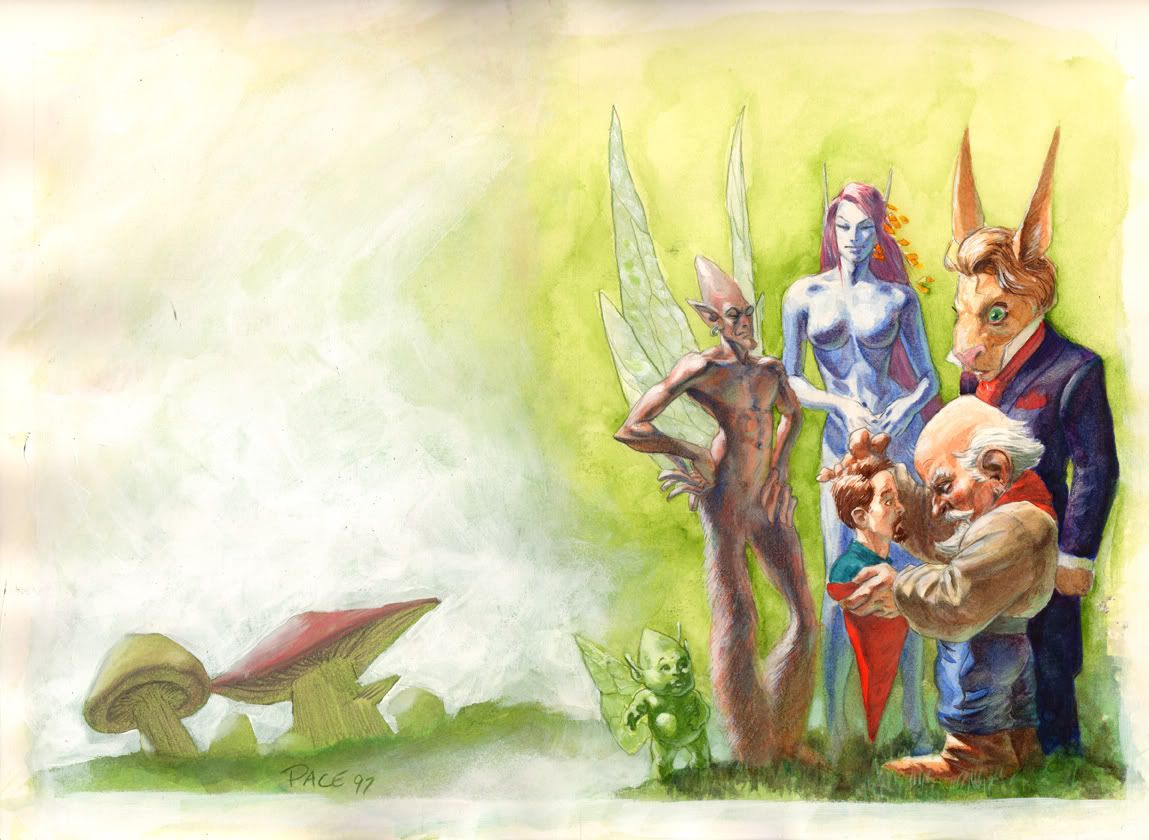
Years ago I was invited to be a part of the initial B&W Image line Jim Valentino was starting up. This was around 1996-8 -- can't really be sure. At the time I was already playing around with a creator-owned project. I was calling it Jack Magic and I was juggling two versions of it; one a very light stranger in a strange land version and a darker version that owed a lot to weird mix of reading on darker faerie tales, Northern Ireland and video game development.
I did a few pieces as I played with it and the one above is one of them, just today uncovered from a pile of stuff in my old studio space. Family stuff got seriously in the way of my following through with Jack Magic, so the above piece just ended up on my website of the time.
Weirdly, it attracted some strange amount of attention; twice I had film producers contact me with interest in optioning the story (since there wasn't anything more to it than that, nothing happened) and I was asked by some Northern European RPG company to use parts of the image for their website and mascot.
It was a real quick watercolour & pencil crayon piece and was a pile of fun to do.

Sunday, 3 August 2008

Marvel Masterworks Artists Proof Cards

Artist's Proof cardsI have two sets of 10 artist proof blanks from the past Marvel Masterworks sets I contributed to and haven't done a one of them. I'm about to get really really busy, so I want to do these before I get swamped again.
They look like this:


I'm going to do these as commissions, charging 40.00 for black and white and 80.00 for full colour. I'm only making 9 from each of these available as I'm planning to do one from each set in colour and make them available to a comics-related charity.

We're coming up on the one-year anniversary of the passing of my good friend Mike Weiringo, so I'm leaning towards choosing one of his preferred charities.I have to work within the restrictions of the regular set: no smoking, no animated or film versions of the Marvel characters, no Howard the Duck, nude versions, zombie versions or licensed characters Marvel published.

Upper Deck and Marvel will have to approve all of these before I deliver them, of course. PM me or e-mail me at richardpace (at) rogers (dot) com or something to let me know what you want.

I'll prolly keep updates of how many and which ones are available as this proceeds.Oh, Paypal will prolly be the payment mode of choice here.

~Richard

Tuesday, 29 July 2008

Dr Sketchies: Completely Gaye!

Sorry about the bad pun. The scheduled model was Nina Arsenault, but she was overbooked and we we got the wonderful Gaye Boston instead.

Really!

So my disappointment in missing an opportunity to draw a T-girl Jessica Rabbit was certainly wiped out by the impressive physicality and poses Gaye brought to the stage.

The drawings don't do her justice -- I felt a little off last night, repeatedly thinking slower than I needed to for the time allowed. It could have been the heat. . . .

Tuesday, 22 July 2008

Green Lantern for George


Here's a sketch for the manager of the Toronto comics (and so much more) shop, The Silver Snail! He's a monster GL fan, so gets a Hal doodle in his wee little sketchbook.
~Richard

Sunday, 20 July 2008

The Smallest Legionaire

Woke up this morning and was reminded that I was suposed to draw a quick card for my son's best friend's birthday. He's really into the ancient Romans, so this was the result:
Would have loved to spend more time on it, but I was scrubbing colour in in Pshop while my wife and son were standing over me, waiting to go to the party.
Makes me think I should figure out a way to bring my computer set up to cons and do sketches this way. . .
~R

Tuesday, 15 July 2008

Dr Sketchy's -- July 15

Manged to finally make it to another Dr. Sketchy's Anti-Art School in Toronto last night.

The model was all sorts of awesome. Her name's Laura Selenzi and she's got a website! Feel free to check it out and see how poorly I failed at getting near how gorgeous and sensual she is.

Her costuming was excellent - -would love an opportunity to actually do a much longer study or painting of her to attempt to capture how ornate and beautiful the clothes are.

There were the usual drink contests -- I drew the above one when we were suposed to partner up for some sort of Batman-themed version of her. I was sitting next to people not too interested in goofing, so I just gave her comic book boobs and didn't enter.

I arrived around 10 minutes late and ended up sitting wayyyy at the back, but a few people bailed around halfway through and I got front row seating for the rest of the night!

This contest was the first of the night -- draw Laura with/as/or something with a genie. I went for Genie Jackson!
Hah!
. . .
Well, it was the best I could come up with --I took too long to polish it off and ended up not even entering. One of my former students ended up winning the goldshlager (sp?) cocktail.

Next one's on the 29th -- hoping to make that one too! I got a Dr Sketchy's link to the right for anyone interested in checking it out.

~Richard

Wednesday, 9 July 2008

Third Year part 2


After the set-up of knowing what will happen for the last part of third year (see previous entry) the first semester of the third year almost determines itself:

Monday
Advanced Penciling
Life Drawing III

Tuesday
Intermediate Storyboarding
Anatomy: Arms and Torso

Wednesday
Advanced Inking
Advanced Painting

Thursday
Intermediate Concept Art
Life drawing III

Friday
Illustrative Painting
Non-human Anatomy

Advanced Penciling
After the previous iterations of penciling, we get a course where the advanced practicalities of drawing for comics on an ongoing basis are dealt with. All the fundamentals must be understood to proceed here. The course load should clip along at a page a week so the homework load would be intense. Pages would essentially cover a variety of regular situations for comics artists; special effects sequences, urban, suburban, rural, and natural environments. The practical application of lighting and staging and other aspects of drawing applied to the moving camera of the artist would be explored, all with an eye to the work being handed off to an inker. Evan if the penciller never plans to allow another inker to touch his work post-program, the experience of drawing to that level of precision and finish is a valuable one.

Life Drawing III
The focus will be on understanding how the body moves, carries weight, rests as well as taking observations from the real body to enrich the student’s work as a whole.

Intermediate Storyboarding
This obviously follows up from a Beginning Storyboarding class. Assuming the fundamentals and language of contemporary storyboarding was absorbed, this class would deal with the practicalities of producing boards for TV, animation and film as a possible alternate or cooperative career choice for a comic artist.

Anatomy: Arms and Torso
I would think what this would cover would be self-evident, but my recent experience shows otherwise. This course would provide a variety of constructive methods to draw the arms and torso without ready reference as well as educate the artist on the skeletal and muscular anatomy as well as the kinesiology (how the body works).

Advanced Inking
Much like Advanced Penciling, this class would move at a page a week and assume the student mastered the fundamentals of the previous two iterations of the inking class. A variety of inking challenges would be presented, from content of the page action to a variety of artists’ styles to deal with. Even if the student never plans to ink another artist (or even their own work), the knowledge gained by going through the process would greatly strengthen their core drawing skills for their own work.

Advanced Painting
This would follow the previous painting courses by dealing with painting the figure as well as painting on location.

Intermediate Concept Art
Much like Intermediate Storyboarding this course would follow a primer on what the artist is expected to do in this field. Since many of the aspects of the current concept art field are skill specific, this course would stick to the skills most developed in the comics curriculum. Focus would be on character design, turn-arounds, prop and environment design. This course would also show how and where comics artist most often enter the concept art field.

Illustrative Painting
The practicalities of colour illustration would be covered; from how traditional to digital media are used and how to best communicate with the client and satisfy their needs. Specific assignments would cover comic covers, book covers, interior illustrations for textbooks and other books. Again, like storyboarding and concept art, this course would show how a comics artist could use their skills as an illustrator as a sister field.

Non-human Anatomy
This would be an intense overview of how animals and other creatures are assembled. Common comics related animals would get more focus (pets and work animals), but a broad understanding of how invertebrates, insects, birds and other creatures anatomy works enables the artist to inform the structural anatomy of aliens or monsters they may eventually design with a touch more realism.

So that would be what’s facing the student as they enter the September of their last year; essentially a polish on the comic skills they developed and a broadening of how they could apply them after they graduate.
Next time I come to this I’ll probably explore the entirety of how I’d like to see the second year work.

~R

Monday, 30 June 2008

Back from Chicago


Chicago went reasonably well.
Pretty much hung out doing not much of anything but watch my pal, Ethan, draw his ass off all weekend.
The news early Saturday morning of Mike Turner's passing was harsh; I had met and hung out with the gentleman a few times in the 90s and he impressed me as a big-hearted and friendly person. Another taken too soon.
~Richard

Thursday, 26 June 2008

Off to Chicago


Off to Wizardworld Chicago tomorrow. . . I hope!
United Airlines called earlier this evening and cancelled my morning flight -- no reason given, but the weather looks horrendous, so that might be it.
. . .Aaaand, I like drawing the Joker!
~Richard

Sunday, 15 June 2008

Starting At the End: Building a Better Comics Art Program


The Third Year

In this installment, I want to look at how the final semester of a third year comics art program could best be constructed for the graduate to best meet the program goals covered previously.

I’m going to structure all three years like this: two semesters, each 14 weeks long, each week consisting of 5 days with two 3-hour classes. This would likely be more flexible at the program neared reality, but it should serve as the armature to build the program around.

I had decided that most of the final semester would be taken up with Portfolio Development, but this will be the most atypical course in the entire program as various students will be aiming for various targets. With that in mind, let’s leave the time allocated to that until after we determine what’s important enough to take time away from it.

Professional Development would be such a course. A course dedicated to informing the student on the hows and whys of the functioning of the comics industry. Everything from making initial contacts, self-promotion, developing relationships, and publishing agreements of all the many sorts running about would be covered. Yeah, making sure the graduate knows exactly how to function in the industry is certainly important enough to take time from building the portfolio. Once a week for three hours.

Life Drawing. I expect that all of second year and first semester of third year would have more intense exposure to drawing from the model, having it scheduled once a week for 3 hours should be enough to allow continued growth.

Painting the Costumed Model. Another course that would allow the student to further develop skills and abilities introduced earlier. Thanks to digital media, painted comics are making something of a comeback, so continuing work with coloured media would be a positive development for more than just the computer colourists. I think one three hour session a week spent on a small painting would be adequate, though I’d prefer spending six hours on this.

Already I’ve taken 9 (or 12 if I expand painting) hours out of the students’ week to maintain skills support and provide career information. As far as an expected 40+-hour work week, I’m already cutting the students down to 28-31 hours to spend on their portfolio work per week. If they were mandated to come into the school three times a week with “off-days” either working from home or at the school facilities, they would get their first taste of independent work.

Our second semester could look like this, then:

Monday
Life Drawing IV
Portfolio Development
Tuesday
Unsupervised Portfolio Development
Wednesday
Painting the Costumed Model
Portfolio Development
Thursday
Unsupervised Portfolio Development
Friday
Professional Development
Portfolio Development

The end result allows for three supervised (or mentored) work sessions for Portfolio Development as well as two full days of time allowed to do the actual work either at a home studio or at school facilities. The two fewer days allocating teaching hours should result in a slightly lower tuition if only for that last semester.

The cheesy drawing at the top really sums of up many aspects of this; there's a tremendous amount of. . . stuff to cram into a very small period of time.

By taking a good hard look at all the material and what the student really needs we might be able to find a way to more effectively concentrate the information to suit the delivery package.

Next time, when I go on about this I'll assemble what I think would make a good first semester for the third year.

~R

Monday, 9 June 2008

Building a Better Comics Program


I really don't think the contemporary methods of teaching art is either healthy or developing. Institutions are either stangnant and entrenched in the methods that have been in place for decades or looking too far back in art history for a different answer to developing realist skills. perhaps, when faced with the zombie state of the modern visual arts curriculum, digging up the even older corpses of art programs is preferable -- if only to avoid the stench of decomposition.

I had never done any course development or actual teaching prior to being invited to help build the comics program at the Max the Mutt Animation School at the beginning of 2006. They were really looking for a two-year add-on to their established first year Visual Arts Literacy program. Already established programs from the animation curriculum would be plugged in as appropriate, as well. Plug and play. I didn’t know enough to know how bad those initial decisions were!

Anyway, the government forms describing the curriculum needed to be written without really knowing how long things would need to be effectively taught or who would be teaching them. Lots of guessing was made in order to make the approval deadline to announce the program for the 2006 fall semester. In retrospect, some of that guesswork was right and some was wrong. Hell, some was downright stupid.

However, now I have a certain amount of experience and I’m in a position to think aloud about what would make an effective and versatile comics curriculum. I don’t want to be a Utopian here; I want to think along the ideas of what would function in the real world so I have to start with some limitations:
A three year program.
A year consists of 2 semesters of 12-14 weeks each.
Students should have 6+ hours of classes a day.
Students shouldn’t typically expect to do more than an hour of homework per hour of instruction.

I’ll also have to start with some goals, but that raises the specter of what I consider a weakness in what I already developed. One of the big mistakes with the previous program is that the goals aren’t there. The program gives students a very broad range of knowledge and skills, but advancing requires competence in all of them, even skills beyond the actual career needs the student requires. The idea was that graduates would be able to do it all and well or not graduate. Specialization isn’t taken into account; would-be inkers or colorists would have to pencil at a graduate level to, well, graduate. Understanding how to draw and do storytelling would certainly make these students better inkers and colorists, but potentially denying them a diploma for an uneven skill set is a problem when it won’t diminish their professional status.

Another issue I have is in weakening the program focus for parachute classes. A two-semester Children’s Book Illustration class was shoehorned into the third year. I was dubious about it at the beginning. I made attempts to have the focus shifted to Book Illustration and Production so the skills would be more transferable toward comics work (designing graphic novels, trade dress, understanding type, and etcetera.), but they came to naught. If a secondary set of skills needed to be enhanced to allow some sort of back-up employment, then the options should feed the main focus in some way. Most of the comics people I know have done both storyboards and concept art in addition to comics work, or have left comics to follow those careers. I’ve done children’s book illustration, it’s a very different field from comics with very few points of intersection with the comics skill set.

With some major weaknesses identified, I can address goals again:
Program should be versatile enough to allow skill focus and career specialization
Program should offer some education in related fields with a high degree of shared skills
Students should be employable upon graduation.

That last one is the biggie. Artists are usually like quarterbacks; they get better with experience and after they’ve been whacked to the ground a few times. Ensuring a student is ready to professionally pencil (or ink, or colour) a book after three years of college is a tall order.


With such a specific and modern set of goals, I really don't think that many of the old ways of doing things can be brought to the table. Spending 20+ hours doing an exact and measured study of a plaster cast may develop a valuable set of skills for the imaginative artist, but no broad-based 3-year program can really afford to take that much time on a single exercise without being certain the whole of it develops the student in the best and most efficient manner. The skills developed by doing precision work are valuable, but the resurgent Atelier system is too cumbersome for a modern program.

I believe it can be achieved, and I start to explore how I think it might be done next update.

Sunday, 8 June 2008

Stealth Dwarf


Quick doodle from a D&D gaming session (new and improved fourth edition rules!) this past weekend.
It's my pal Stephen's character.
More serious stuff again later. . .
~R

Friday, 6 June 2008

The Evils of Kimon Nicolaïdes


I'm going to start with what will likely be a slightly controversial premise; there’s too much life drawing in first year art school.

Having said that so simply, I now can take the time to put that in context; if the goal is to produce a graduate who can enter a field where they need to draw the human figure from their imagination is paramount (comics, concept art, animation, storyboarding, etc.) the ability to draw from a nude figure placed upon a lighted stage is actually of little use.

Drawing from a live figure doesn't teach you how to draw from your imagination, it enhances the ability to draw from your imagination. If you cannot draw a reasonably competent figure from your imagination, then life drawing classes a nearly a waste of your time. This leads me to talk about the much-lauded life drawing course written by Kimon Nicolaïdes and what, exactly, is wrong with any school using it as the first-step for developing would-be art professionals.

I think I can speak with some authority on Kimon Nicolaïdes's The Natural Way to Draw and how it seems to be most often used in contemporary Art School classrooms. Years ago, when I went to Sheridan Illustration, it was the primary text for all three years of the life drawing program and I just spent two years teaching a Beginning Life Drawing course built off of the book (with small portions cribbed from Bridgman and Hale), so I'm pretty intimate with the work.

For those new to the book, it describes in great detail a program of drawing from the model, 3 hours a day, five days a week for 25 weeks. The course is varied and quite expansive, often using "ah-hah" kinds of exercises to get the student to develop a better understanding of energy, weight, mass and movement and how to represent it on paper. His language is often oblique or dense and feels like a book written for a different age, which it is; Nicolaïdes finished writing it in in 1936. That really shouldn't matter since rules of usage haven't changed that much in 70 years, but the contemporary student really shouldn't have to puzzle out meaning from baroque paragraphs vaguely describing the intent of an exercise.

An aside, Harold Speed's most excellent The Practice and Science of Drawing was first published in 1917 and reads far more clearly that Kimon's how-to book.

Back to The Natural Way to Draw; it posits an environment where the student draws for three hours every day for 25 weeks. Will a student get better for having gone through it? Yes, of course, most art students haven’t done that much drawing in their entire lives previous, so just the act of doing that much drawing will pay off with general improvement. However, I can't think of a single school that spends that much time with the model. One of the best things about Nicolaïdes's program is its intensity, and no one can follow through on it.

The school I just taught at was considerably more intensive than any other I'm currently aware of at two weekly 3.5 hour classes and a 3 hour lab (unsupervised drawing time with model) per week. In one year of two twelve week semesters you could theoretically cover most of the course. We didn't, actually only covering 8-9 weeks of it, with other elements (such as drapery) dropped into another course; Principles of Drawing.

With this less-then-perfect application of the program, what do we really have? An incomplete process to draw from a live model better than you did at the start. The Natural Way to Draw doesn't do what the potential visual arts communicator needs more than anything; teach him or her how to draw.

There's more valuable information in Buscema's How to Draw Comics the Marvel Way for the practical needs of the professional artist than in Nicolïades's book.

For an artist to apply gesture, line sensitivity, an understanding of weight and mass to an imaginative drawing there has to be something to hang those embellishments off of, some sort of process to create the figure without reference. Bridgman saw this, as did Andrew Loomis, Frank J. Reilly and (gah -- please don't think this is a recommendation) Hogarth.

Before an artist can really apply the benefits of life drawing to imaginative drawing he or she needs to be able to draw a reasonably accurate manikin and that requires an understanding of proportion and structure and the ability to judge the relationship between somewhat abstract shapes on a 2-dimensional surface. Starting new students with blind contour studies and running-line gesture day one is doing them a disservice. The only students who seem to thrive are those who already have a firm grasp of the basic figure entering the school.

If I were developing a new program that was intended to meet the needs of visual communications artists, use of the live model would be limited in the first year. Instead I would have the students study proportion, structure, their ability to assess what they've drawn for consistency and accuracy, and provide them with a variety of situational manikins to be able to draw the basic figure from their imagination. A model would be used during this process, but it would be limited, and in support of reinforcing the theory.

Once that was accomplished, then a full life drawing program could commence and the students could really start to glean useful information for their future careers. I'd probably still crib things from Nicolaïdes for that, but it would be with the understanding that the life drawing course would have to be in service to the careers of the students, not in service to an ideal of fine art drawing in and of itself.

Again and again, as both student as teacher, I've run into the situation where "not enough time" was the reason things weren't done more fully or effectively. Perhaps the solution shouldn't be to cram the traditional process into a smaller window, but to come up with a new process that understands how small the window is.

I feel I faced that challenge effectively for the Design and Composition course I developed, taking what should have been a year long program and produced a 12-week course that essentially forced the student to be constantly engaged in observing design around them while they learned the simplified principles and terms. I worked backwards from the goal and developed a process that made it inevitable.

Could that type of thinking be applied to an entire program for comics and concept art? I think so and I look forward to taking up that challenge in the future.

~Richard

Thursday, 24 April 2008

Process stuff


Above are a bunch more character sketches for the X&X story I was supposed to start work on wayyyyy back in January. The owner of the world's most popular fantasy role-playing game finally gave approval about three weeks back, but I am too overcommited to continue with it on the new, very tight deadline.

These are the thumbnails I did for the 20 pages. These were enlarged, printed out in blue on 11x17"paper then tightened before tracing them to 2-ply bristol board. I also built a 3-D model of the tavern interior in Google Sketchup to make the backgrounds go faster.

Been playing with Sketchup for a while now -- it's a pretty simple and versatile tool for the comics artist. Some of my pals are suggesting other programs, which I should try as well.

~R

Note --I've been asked to remove specific mention of the company who owns the licensed property and the property itself as it might mess with the contract between the publisher and the IP owner.

Friday, 21 March 2008

Lord Something

Earlier this week I got the script for my part of Worlds of Something & Something #3 (from Devil's Due). James Lowder did an excellent job adapting his own short story.
Was chomping at the bit to get my school commitments this week met to start on this (and continue work on my contrib to the Tori Amos project, which I'm not allowed to show any of the work). Did a few a few sketches of the Big Bad of the Something setting himself: Lord Something.

I'm not colouring this, but with all the digital painting I've been doing for the other thing, it felt odd not adding a splash to the pencil sketches in my book.
~R
Been asked by the publisher to remove references to the IP as it might interfere with their license -- thus the "somethings".

Sunday, 9 March 2008

More developmental stuff


So, this is why I did the Spider-Man drawing the other day.

The text I wrote on the jpegs is pretty explanatory of what's going on and touches on some of the stuff I'll be teaching and demonstrating this summer.

~Richard

Spiders

Have to do some work showing some developmental stuff for a course I'm teaching this summer on figure drawing without a model. Decided to use Spider-Man. Here's just two of the steps I go through when I'm drawing:

By the stage above I've already done a few thimbnails and had some false starts with portions of the anatomy. I draw on bond paper most of the time: it's translucent so I can trace and redraw whatever I need without a light table or flip the daring and hold it up to the light to reverse it so i can catch errors. About 60% of the work I do is on bond before being scanned into the computer or transferred to art board of some flavour.

I did another overlay drawing of the above before I drew the version below:

Normally I would have gone to Bristol to tighten the drawing up, but this isn't for publication, so I just tightened it up on a new sheet of bond paper before scanning and colouring

It was a nice break from rendering New York City brownstones.

Friday, 7 March 2008

Marvel Sketch Cards


Working on a new batch of Marvel Sketch Cards for Marvel Masterpieces II (I think it's second set -- can't recall). Might play with these further at a later date. Might use some markers to add grey tones or some colour -- not sure yet.

Instead of 50, I opted to go for 100 this time. They make great warm-ups before starting the drawing day or for winding down.

With 100 cards to do I've decided to be a bit systemic: I'm going to draw eleven Marvel characters eight times over nine cards with one last single card to get one character drawn once. No idea who that'll be.

Pretty sure the next ten will be:
  1. Hulk
  2. Iron Man
  3. Spider-Man
  4. Wolverine
  5. Thor
  6. Silver Surfer
  7. Spider-Woman
  8. Ms. Marvel
  9. Scarlet Witch
  10. Storm

~R

Saturday, 1 March 2008

Big things


Wow -- fast month!
Lotsa things going on; six weeks left of school obligations left for this semester, the Tori Amos story needs drawing and painting, I got a 20 page story pending for an upcoming fantasy anthology series (not sure if I can talk about details on that yet) and I'm trying to line up my summer schedule as soon as possible.
I also did some virtual house cleaning; my website-I-never-did-anything-with came up for renewal and I passed on it since I really couldn't see a point where I'd have the time to set it up the way I wanted it to look and function, inspired by that I deleted my myspace account since it was a barely functioning annoyance more often than not. Facebook is doing what I wanted from Myspace, so I'll stick with that. I almost dropped Comicspace as well, but I'll see what the announced relaunch of that social network offers first.
Other than that, I've been chipping away on two projects; one a long gestating fantasy piece and a more recently started historical project. The giant above is from the former, of course. Giants are to be a big part of the fantasy "thing", so they require a great deal of of my attention as it develops. I'm starting to get comfortable with my conceptualization of my giants; longer than human proportion arms, much thicker legs and hips, cruder and different head shapes and their approach to armour.
Giants expecting to fight humans only armour their lower body, possibly wear vambraces and gauntlets and use shields if they were expecting missile fire. I imagine the crotch/belly armour I designed would be uncomfortable.
The historical thing would be a stand-alone graphic novel project, while the fantasy thing already has an intro one-shot (Zero-issue, I guess), a 6-issue mini series and several story points developed. I'm nervous about starting something that may wind up being so all-consuming, which is possibly why I'm doing so much development work on it and avoiding finishing pages!

Sunday, 3 February 2008

Muscles and Teeth


Heck of a weekend: Snow storm ties up my Friday and part of Saturday morning. My first experience with an optometrist since I was 10 effectively blinded me for the rest of Saturday. Today was taken up with getting crap done for the upcoming week and watching the NY Giants become the unlikeliest of Superbowl champions.

Did find some time to draw, not as much as I would have hoped. I wanted to do more than doodle on the Tori project, but my head just wasn't going there with everything else going on.

So it was a continuation of muscled monsters with big teeth. More Hulk and a little bot o' Pitt. I have a good idea of what I'd like to do with the Hulk thing, so look for that germ of an idea to be a more finished piece soonish.